FAQs for Music Creators
- What is Copyright?
1. What is copyright?
Copyright is a legal property right, regulated in Ireland by the Copyright and Related Rights Act 2000. It gives the owner of a creative work—such as a song, a piece of music, a book, or a film—the right to permit or prevent others from using that work.
2. What kinds of works are protected by copyright?
Copyright applies to many types of creative works, including:
- Songs and musical compositions
- Literary works (books, poems, scripts)
- Artistic works (paintings, photographs, designs)
- Sound recordings and films
- Dramatic works (plays, choreography)
3. What rights does copyright give me?
As the copyright owner, you have the right to allow or prevent certain activities—known as restricted acts—such as:
- Making a copy of your work
- Making your work available to the public
- Creating an adaptation or arrangement of your work
4. What is meant by ‘making a copy’?
This includes reproducing your work in any form—digitally or physically. For example, recording a performance, photocopying sheet music, or duplicating a digital audio file.
5. How is copyright different from other intellectual property rights?
Copyright is one form of intellectual property—a category that covers all intangible creations of the mind, such as:
- Copyright (creative works)
- Patents (inventions)
- Trade marks (brands, logos)
- Design rights (appearance of products)
6. How long does copyright last?
The duration depends on the type of work and when it was created, but in general, for musical works, copyright lasts for 70 years after the death of the creator.
7. Do I have to register for copyright?
In Ireland, copyright protection is automatic—you do not need to register your work. It exists as soon as your work is created and fixed in a tangible form.
8. What happens if someone uses my work without permission?
If someone performs a restricted act without your consent, they may be infringing your copyright. You can take action to stop the infringement and may be entitled to compensation.
9. How does IMRO help with copyright?
IMRO (Irish Music Rights Organisation) helps songwriters, composers, and music publishers manage their rights by licensing the public use of music and collecting royalties on their behalf.
10. Where can I learn more?
You can read the Copyright and Related Rights Act 2000 or visit our dedicated Copyright Information section for guidance.
- How do I get paid?
To help reduce costs and streamline administrative processes, IMRO applies a minimum payment threshold for royalty distributions.
Royalties are issued once a member’s accumulated earnings reach €10. At that point, the total accrued royalties will be included in the next scheduled distribution cycle. Until then, members can securely monitor their royalty earnings through the Members Only Area on the IMRO website.
In addition to the standard threshold, two other payment thresholds currently apply:
1. Non-Republic of Ireland (Non-ROI) bank accounts – threshold of €50
2. Cheque payments – threshold of €500
These thresholds help ensure payment methods remain efficient, cost-effective, and aligned with IMRO’s commitment to providing a seamless, predominantly digital service for members.
- How do I copyright a piece of music?
There is no formal system in Ireland for “registering” copyright in a creative work. Copyright automatically exists from the moment an original work is created and fixed in a tangible form — for example, on a tape, CD, digital file, or manuscript.
However, if a dispute arises over ownership, it’s important to be able to prove you owned the work on a particular date. One commonly used method for establishing this proof is as follows:
- Place your tape, CD, sheet music, or song lyrics in a sealed envelope.
- Clearly write the title of the work on the outside.
- Address the envelope to yourself and send it by registered post.
- When you receive it, do not open the envelope. Ensure the postmark with the date is visible and the envelope remains completely sealed.
- Store the envelope in a safe place, such as with your solicitor or in a bank deposit box.
This process can help provide evidence of the date of creation in the event of an ownership dispute.
- How often will I receive a royalty statement?
IMRO is one of the most efficient performing rights organisations in the world, providing frequent royalty distributions to members and affiliated societies worldwide — with no additional administration fees on royalties earned from international public performances of your works.
Royalty statements are issued whenever a distribution takes place. The frequency depends on how and where your works are performed, but members can expect:
Monthly statements for royalties from:
- Online performances and streaming services
- Major Live Events
- Live Classical performances and recitals
- Overseas performances of your works
Four major domestic distributions each year for other performance types in Ireland.
Each statement provides a detailed breakdown, including the total amount earned, individual work titles, performance sources, your share in each work, and the amount earned.
Because analysing performance data and allocating royalties is a complex process, there is always a time-lag between IMRO receiving revenues and issuing distributions. However, our monthly and quarterly schedules ensure you receive royalties as quickly as possible.
- What is a royalty?
A royalty is a payment made to the copyright owner of a musical work when it is publicly performed or used.
IMRO collects licence fees from broadcasters, online music providers, venues, pubs, hotels, and many other businesses that use music. Once this revenue is collected and analysed, it is distributed as Public Performance Royalties to the copyright owners of the works that were played or performed.
In other words, royalties are your earnings when your music is used — whether on the radio, streamed online, performed live, or played in public spaces.
- I write music for film. What do I need to do?
To ensure you receive royalties promptly and accurately for music used in films, follow these steps:
Register your works with IMRO
- Register each cue under its individual cue name.
- Also register the full movie title.
This ensures the efficient and timely payment of royalties from public performances of the film.
Ensure cue sheets are submitted
- The film’s producer should send cue sheets to IMRO.
- Check that each cue sheet lists the correct cue names, durations, and other details.
Send documentation to IMRO
- Send a copy of the cue sheet directly to IMRO yourself.
- Include a completed works registration form for any new works.
For more details on registering music for film or works registration in general, please email distributions@imro.ie
- How do I become a member of IMRO?
Membership of IMRO is open to songwriters, composers, and music publishers who meet certain eligibility requirements.
To apply, you will need to:
- Complete the IMRO membership application form – available on the IMRO website.
- Provide examples of your work – you must have had at least one of your original musical works:
- Publicly performed, or
- Broadcast, or
- Commercially recorded and released.
- Submit supporting documentation – such as proof of performances, broadcast logs, release details, or cue sheets (for film/TV music).
- Return the signed agreement – confirming IMRO will represent your performing right in your works.
There is no joining fee and, once accepted, you’ll be entitled to receive royalties when your music is performed publicly, broadcast, streamed online, or otherwise exploited.
Full details and the online application form can be found in the Join IMRO section of the website.
- If I am in a band do all need to become IMRO members?
If you are in a band, only those members who contribute to the songwriting or composing process — and who meet IMRO’s membership requirements (outlined here) — are eligible to join.
Band members who do not write or compose music do not need to become IMRO members.
- Can I copyright the name of my band?
No. Copyright law does not apply to names.
However, you have two main options to help protect your band’s name:
Register the name as a business name
- This can be done with the relevant business registration authority in your country.
- It helps prevent others from registering the same name for official use.
Register the name as a trade mark or service mark
- This can be done through your national or regional intellectual property office (e.g., the European Union Intellectual Property Office, the United States Patent and Trademark Office, etc.).
- A registered trade mark can prevent others from trading under the same or a confusingly similar name in the regions where it is registered.
- If you want protection worldwide, you’ll need to register in each territory where you intend to operate, or use systems such as the Madrid Protocol for multi-country trade mark protection.
For comprehensive information, including costs and application processes, contact the relevant intellectual property and business registration offices in the countries or regions where you operate.
It is strongly recommended that you seek independent legal advice before proceeding.
- Can I still be a member if I am resident outside of Ireland
Yes. Your place of residence does not affect your ability to become an IMRO member.
As long as you meet IMRO’s membership requirements — outlined in the Become a Member of IMRO section of this website— you can join, regardless of whether you live in Ireland or elsewhere in the world.
- Do IMRO administer Grand Rights?
No. IMRO does not generally administer what are known as Grand Rights — these usually cover the performance of dramatico-musical works (such as operas, operettas, musicals, revues, or pantomimes written specifically as such) and ballets (choreographic works with a story, plot, or abstract idea, performed through dance or mime).
However, IMRO does administer these rights in certain cases, including:
- When dramatico-musical works or ballets are performed via films made primarily for cinema release, including TV broadcasts of such films.
- When such works are performed in public by means of radio or TV sets (e.g., in hotels, pubs, or public venues).
- TV broadcasts of short ballets (up to five minutes) written for television, or excerpts from existing ballets.
Excerpts from dramatico-musical works:
- Dramatic excerpts are generally controlled by the copyright owner (unless IMRO is authorised to license certain broadcasts).
- Non-dramatic excerpts are controlled by IMRO if they meet specific limits:
- Public performances: up to 25 minutes, not a complete act or condensed version.
- Television: up to 20 minutes.
- Radio: up to 25 minutes or 25% of the full work, whichever is less.
Other exclusions:
- Public performances (but not broadcasts) of music for son-et-lumière productions or dramatic theatre productions when used in conjunction with the production.
- In some cases, words written specifically for commercial advertisements.
Note:
- Non-dramatic excerpts exceeding these limits must be licensed directly by the copyright owner.
- Ballet music (complete or excerpt) is controlled by IMRO when not accompanied by a visual ballet performance.
- If a specially written dramatico-musical work begins as a film, broadcast, or recording and is later adapted to the stage, IMRO does not control the stage performance.
- I write music for advertising commercials. How does IMRO treat these works?
IMRO treats music for advertising in exactly the same way as any other music you create — whether it’s a full composition, signature tune, background score, or jingle. You will receive payment for the use of this music when it is broadcast on radio or TV.
For advertising jingles specifically:
Make sure the advertising agency you work with submits the correct music details to radio and TV.
These details usually include:
- Product name
- Music title used
- Composer’s name
- Duration of the music in the advert
Always confirm with the agency that you have been credited correctly before the campaign goes live.
This ensures IMRO can accurately track and pay royalties for your work.
- I have a residency and I will also be playing at a number of festivals. Do I need to inform IMRO?
Yes. IMRO needs details of both residencies and festival performances to ensure you receive the correct royalties for your live performances.
For residencies (e.g., regular gigs in a bar, hotel, or venue):
- Provide the start and end dates of your residency.
- Specify the day(s) of the week you perform.
- Include a set list of the works you perform.
For festival performances:
- Submit the festival name, date(s), and a set list for your performance.
Providing this information allows IMRO to track your performances accurately and process your royalty payments efficiently.
- How do I register a set and submit a gig? [Video]
- How do I register a work? [Video]
- How do I get royalties from a Grand Right?
IMRO does not generally administer Grand Rights (such as for dramatico-musical works and ballets).
To receive royalties from a Grand Right performance, you must negotiate directly with the user of your copyright works — for example, a theatre company, production house, or event organiser.
If you have a publishing deal, your music publisher will normally handle these negotiations and royalty collections on your behalf.
- What is a Grand Right?
A Grand Right generally refers to the performance of:
- Dramatico-musical works – for example, an opera, operetta, musical play, revue, or pantomime, where the words and music were written specifically for that production.
- Ballets – choreographic works with a story, plot, or abstract idea, created for interpretation through dance and/or mime. This does not include country or folk dancing, tap dancing, or precision dance sequences.
Grand Rights typically apply when these works are performed in their full dramatic form, such as in a staged production.
- Where does IMRO get all its music performance information from?
IMRO collects performance data from a variety of sources to ensure accurate royalty distribution.
Broadcasts
- Broadcasters licensed by IMRO provide programme logs of all music used.
- IMRO also monitors radio and TV output on a random sample basis to verify accuracy.
Online music platforms
- IMRO receives usage data from licensed online music providers (such as streaming services, digital radio, and on-demand platforms).
- This data includes detailed logs of music played, ensuring digital performances are tracked and royalties allocated properly.
Live performances
- For classical concerts, revenue is distributed based on actual concert programmes.
- For other genres, revenue is distributed based on set lists provided to IMRO.
- Tours and residencies use representative set lists where available.
- Members can submit set lists and tour/residency details quarterly for the previous three months.
- Remaining live performance royalties are allocated using independent venue surveys.
Recorded music in public places
Royalties for performances via recorded means (e.g., jukeboxes, background music, radio/TV in public spaces) are distributed using industry data such as record sales charts, streaming data and broadcast transmission details.
By combining direct reports, surveys, monitoring, and industry data, IMRO ensures royalties are distributed as fairly and accurately as possible.
- I’m a classical/contemporary composer. What information does IMRO need from me?
To ensure you receive the correct royalties, IMRO needs you to provide:
- All programme returns for performances involving your works.
- Dates and venues of concerts and recitals where your music is performed, both in Ireland and internationally.
IMRO licenses and collects royalties for classical and contemporary performances, calculating payments for each separate event. The more detailed and accurate the information you provide—such as full programmes and performance details—the better IMRO can ensure you are properly credited and paid.
While this may feel like self-management, keeping your live performances well documented and submitting all required registration forms correctly is in your best interest.
You can submit all necessary information easily through the Members Only section of this website by clicking the Members Login link at the top of the page.
- What’s the position if another artist is performing my songs?
In addition to the gig information you provide about your own performances, IMRO also surveys venues across Ireland and monitors national press and major music publications to track live performances by established artists.
What you can do:
- Ask the performing artist to send their complete set list to IMRO.
- Alternatively, ask them to give the set list to you so you can pass it on to IMRO.
- The set list should include all songs performed, not just your works.
- If obtaining the set list is difficult, provide IMRO with the contact details of the artist’s management or agent so we can follow up directly.
This information helps IMRO accurately track performances of your works and ensure you receive the royalties you are entitled to.
- Does registering a song with IMRO protect it from copyright infringement?
Registering a song with IMRO does not provide full copyright protection, but it does offer supporting evidence in the event of a copyright dispute. Copyright protection automatically exists as soon as an original piece of music is fixed in material form (e.g., a recording or manuscript).
IMRO registration helps establish ownership and usage history, which can strengthen your case if infringement occurs.
For more on how copyright works, see the FAQ: “How do I copyright a piece of music?”
- How long does copyright last?
Copyright duration varies from country to country, but in many places — including the European Union, the UK, the USA, Canada, Australia, and others — the general rule for literary, dramatic, musical, and artistic works is:
70 years after the death of the author (often called life plus 70), regardless of when the work was first made available to the public.
Examples of variations:
USA: Generally life of the author + 70 years for works created after 1977, but different rules apply to works made for hire, anonymous works, or older works.
Canada, New Zealand, Japan: Life of the author + 70 years (recently updated in some countries; previously life + 50).
Some countries (such as many in Africa, Asia, and the Caribbean) may still use life + 50 years unless updated by national law.
Always check the laws of the country where you want to enforce your rights, as copyright terms and rules for special cases (e.g., joint authorship, sound recordings, films) can differ.
- Do IMRO provide funding for projects?
Yes. Each year, IMRO sponsors a wide range of music-related initiatives, including:
- Song contests
- Music festivals
- Seminars and workshops
- Research projects
- Showcase performances
Through the IMRO Sponsorship Programme, we aim to foster and develop creativity across all music styles and genres, with a strong focus on supporting emerging talent.
If you have a project you would like considered for funding, please complete our online application form here:
🔗 Apply for IMRO Sponsorship
- I don’t recognise a work for which I’ve received a royalty. What should I do?
If a work appears on your royalty statement and you do not hold a songwriting or publishing interest in it, contact IMRO’s Distribution Department immediately to raise a query.
Quick action ensures any errors can be investigated and corrected promptly.
Email: distributions@imro.ie
- How are royalties generated?
Royalties are generated when your music is publicly performed, broadcast, streamed online, or used in licensed venues such as pubs, clubs, shops, hotels, or festivals. IMRO collects licence fees from these music users and distributes the revenue to members based on detailed performance data.
- The amount you receive depends on several factors, including:
- Where and how your music was used (e.g., live, broadcast, online)
- The duration and frequency of the performance
- Your ownership share in the work
- The availability and accuracy of performance reports (e.g., set lists, cue sheets, usage logs)
For a complete and comprehensive guide to how royalties are calculated, please refer to the Royalties Section of this website.
- What do I need to provide to IMRO if I am performing internationally?
If you’re performing live outside your country of residence, it’s important to notify IMRO about these performances to help ensure you receive the royalties you’re entitled to from international performances.
Please provide:
- Dates of your concerts or gigs
- Venue names and locations
- A set list of the music you plan to perform
IMRO will then inform the relevant performing rights organisation (PRO) in that territory so they can identify your performances and forward any collected royalties to IMRO for distribution to you.
If you’ve already performed internationally and haven’t received royalties, you should still send this information to IMRO as soon as possible.
You can submit performance details through the Members Only section of the website by clicking the Members Login link at the top of the page.
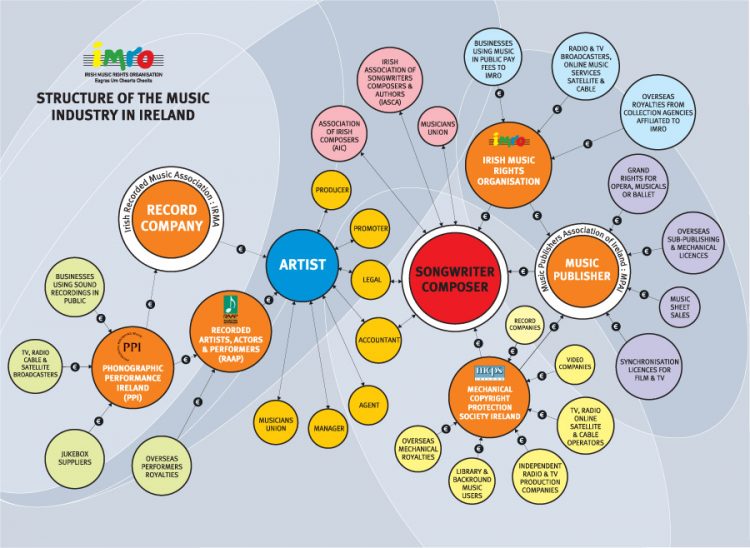
- What is Mechanical Copyright Protection Society Ireland Limited (MCPSI)?
Mechanical Copyright Protection Society Ireland Limited (MCPSI) is an organisation that represents thousands of composers and publishers of music. It licenses the mechanical rights in musical works — that is, the right to reproduce music in physical formats (CDs, DVDs, vinyl), online, or as part of audiovisual content.
Through an agency agreement with MCPS UK and reciprocal arrangements with other societies worldwide, MCPSI also represents the interests of global music copyright owners.
MCPSI provides licensing services for:
- Record companies and producers
- Independent filmmakers and TV companies
- Online music services and digital distributors
- Importers of recordings from outside the EU
- Anyone wishing to use music in recorded formats
It collects and distributes royalties on behalf of music creators whenever their work is used in these ways.
📍 Contact MCPSI
Address:
Mechanical Copyright Protection Society (Ireland) Ltd (MCPSI)
Pembroke Row
Lower Baggot Street
Dublin 2,
Ireland
📞 Tel: +353 1 676 6940📧 Email:
- For CD/DVD clearance & membership: mechanicals@imro.ie
- For general, online & sync licensing: mcps.licensing@imro.ie
- What if someone uses my work without permission?
If you discover that your music has been copied, recorded, or used in a sound recording without your permission, you should take action immediately.
For issues involving unauthorised recordings (also known as mechanical rights infringements), you should contact:
MCPSI (Mechanical Copyright Protection Society Ireland Ltd)
MCPSI represents thousands of composers and publishers of music, and through reciprocal agreements with global societies, also protects the rights of international music copyright holders. It licenses companies and individuals who record music and collects and distributes royalties from those recordings.
If someone has recorded your work without permission:
- Contact MCPSI with full details of the infringement.
- Include evidence of where and how the work was used.
- MCPSI can advise you on the next steps, including how to pursue missing royalties or stop unauthorised use.
📍 Contact MCPSI
Address:
Mechanical Copyright Protection Society (Ireland) Ltd (MCPSI)
Pembroke Row
Lower Baggot Street
Dublin 2, Ireland📞 Phone: +353 1 676 6940
📠 Fax: +353 1 661 1316
📧 Email: mcps.licensing@imro.ie - What are Mechanical Royalties?
Mechanical royalties are payments made to songwriters, composers, and music publishers when a musical work is reproduced or distributed in physical or digital form. This includes:
- CDs, vinyl records, and cassette tapes
- Digital downloads (e.g., iTunes purchases)
- Streaming services (such as Spotify, Apple Music – for both downloads and interactive streams)
- Ringtones and mobile music uses
- Synchronised audio in visual media (in some cases, e.g. DVDs)
- Imported recordings (from outside the EU)
These royalties are called “mechanical” because they stem from the mechanical reproduction of music — originally referring to piano rolls and now applying to modern formats.
Who collects mechanical royalties?
In Ireland, mechanical royalties are collected and distributed by:
MCPSI
(Mechanical Copyright Protection Society Ireland Ltd)
They license the right to reproduce musical works and ensure that the rightful copyright owners are paid when their music is recorded or distributed.
Through reciprocal agreements with other global societies, MCPSI also helps ensure mechanical royalties from international uses of your music are collected and returned to you.
📧 Contact MCPSI
- CDs/DVDs and Membership Enquiries: mechanicals@imro.ie
- General and Online Licensing, Synchronisation: mcps.licensing@imro.ie
- Phone: +353 1 676 6940
- Address: Pembroke Row, Lower Baggot Street, Dublin 2, Ireland
- Do I need to tell you if I am are aware of a broadcast of my works?
Yes. If you are aware of any broadcasts of your music—especially outside of your home territory—it’s important to notify IMRO. While IMRO receives broadcast data directly from local broadcasters, including full reports from all major stations, informing us of known broadcasts helps ensure your royalties are properly tracked and collected.
For international broadcasts, IMRO can alert the relevant collection society abroad to help facilitate payment to you.
You can submit broadcast details through the Members Only section of the website or contact our Distribution Department at:
Be sure to include:
- Date(s) of the broadcast
- Station name
- Country of broadcast
- Title(s) of the work performed
This helps improve the accuracy and speed of your royalty payments.
- I am an IMRO member – am I automatically a member of MCPS?
No. Membership of MCPS (Mechanical Copyright Protection Society) is separate from IMRO and is not automatic.
If you wish to earn mechanical royalties—which are generated from the reproduction of your works (e.g., on CDs, downloads, streaming platforms, etc.)—you will need to apply for membership with MCPS separately.
For more information or to apply, you can contact:
📧 mechanicals@imro.ie – for CD/DVD clearance and membership
📧 mcps.licensing@imro.ie – for general licensing and online uses
- I’m an arranger of traditional works. Should I register them with IMRO?
Yes. If you arrange traditional works, it is essential that you register them with IMRO.
You must register every song, tune, or melody that you are:
- Writing
- Co-writing
- Or arranging, even if it’s based on a traditional (public domain) work
This ensures IMRO can properly identify your contribution and pay you the royalties you’re entitled to.
Arrangements of traditional works are treated the same as original compositions in terms of royalty distribution—so it’s in your best interest to register them, especially if:
- You’re performing them live
- They’re being broadcast on radio or television
If they’re not registered, IMRO will be unable to allocate any royalties to you for their use.
Don’t miss out—register your traditional arrangements as soon as possible.
- What are the criteria for writer membership of MCPS?
To be eligible to apply for MCPS writer membership, you must meet both of the following criteria:
- You own or control the copyright in at least one piece of music (i.e. you are unpublished),
and - At least one of your unpublished works has been:
-
- Released for retail purposes by a record company (other than one you own), or
- Used in a radio, TV, audio-visual, multimedia production, or download.
If you meet these requirements, you should consider applying for membership.
How to apply:
- Complete the MCPS Membership Form
- Review the MCPS Membership Agreement
- Return the completed form to:
Mechanical Copyright Protection Society (Ireland) Ltd (MCPSI)
Pembroke Row
Lower Baggot Street
Dublin 2
IrelandFor any queries about MCPS membership, email: mechanicals@imro.ie
- You own or control the copyright in at least one piece of music (i.e. you are unpublished),
- I have some songs – how do I go about getting them to performers?
There’s no single “right” way to get your songs to performers, but here are some helpful steps to consider:
Identify the right artist or performer:
Focus on artists who are likely to record or perform the style of music you’ve written. It’s best to avoid contacting performers who don’t align with your music’s genre or style.
Contact the right person:
Once you’ve identified suitable artists, send a demo of your material to their manager, publisher, or record company. Be aware that many companies do not accept unsolicited material, so research carefully to find the appropriate contact and preferred submission format.
If you don’t have a specific artist in mind:
Consider targeting music publishers who specialise in your genre. Sending demos to publishers who focus on your style increases your chances of success. For example, avoid sending heavy rock demos to publishers who focus on traditional music.
Doing your research and targeting your efforts will improve your chances of getting your songs into the hands of performers.
- Why is it important to put writer/publisher credits on your recordings?
Including accurate writer and publisher credits on your recordings is essential because these credits:
- Ensure you receive proper royalty payments: Royalties from broadcasts, performances, and sales are distributed based on these credits.
- Help identify your work: Accurate credits allow collection societies like IMRO and MCPSI to track and manage the use of your music.
- Protect your rights: Properly credited works make it easier to resolve disputes or unauthorised uses.
- Increase professional recognition: Credits help build your reputation and connect your work to your name in the industry.
Without correct credits, you risk losing out on royalties and recognition for your creative work.
- How does copyright apply to traditional music?
Traditional or folk music often exists in the public domain—meaning its copyright term has expired and it is free for anyone to use. However, new arrangements or adaptations of traditional works can attract copyright protection if they meet certain legal criteria.
Key Points:
Traditional works are usually no longer under copyright because the original composer is unknown or has been deceased for more than 70 years. These works can be freely used, shared, or adapted by anyone.
Arrangements of traditional music—such as harmonisations, orchestrations, or structural reinterpretations—may be protected by copyright if they involve original creative input and are fixed in a tangible form (e.g., a written score, recording, or digital file).
Ornamentation or variation in live performance alone does not constitute a new copyright. It must be captured in a fixed form to qualify.
Multiple arrangements of the same traditional work may exist, each protected separately under copyright law.
International Context:
The Berne Convention, an international copyright treaty, explicitly allows for new copyright protection in arrangements of public domain works. This supports creativity worldwide while still maintaining public access to the original source material.
Why it matters:
If you create a new arrangement of a traditional song—especially if you plan to publish, record, or license it—it’s important to register it with IMRO to ensure you’re recognised as the rights holder for your version.
- What is Capital Acquisitions Tax (CAT) and how does it apply to gifts or inheritances of copyright?
Capital Acquisitions Tax (CAT) is a tax charged on the value of gifts and inheritances received. When transferring assets—such as copyrights—either during your lifetime or upon death, several tax considerations may apply:
If the transfer is made during your lifetime (a gift):
- Capital Gains Tax (CGT) may apply to the person giving the asset.
- CAT may apply to the person receiving the asset.
- Stamp Duty may also be payable by the recipient depending on the type of asset.
If the transfer happens on death (an inheritance):
- Only CAT applies.
- CGT does not apply on death.
- Stamp Duty is not charged on inherited property.
This also applies to copyrights and intellectual property. The Irish tax system treats the transfer of such rights similarly to other assets under the above tax heads.
For a more detailed overview of the Irish tax implications related to gifts and inheritances of copyrights, you can refer to the following memo:
🔗 Capital Acquisitions Tax Memo (PDF)
🛑 Please note: This material is for informational purposes only and does not constitute legal, tax, or accounting advice. Always consult your own professional advisors before making decisions or transactions involving tax or inheritance matters.
- I perform my works live, do I need to inform IMRO?IMRO requires you to provide the following information on a regular basis:
- the dates of your gigs
- the venues where you played
- set list(s) for these live performances
FAQs For Music Users
- Do tariffs change every year?
Yes. Our licence fees are adjusted annually in line with changes to the Consumer Price Index (CPI) to reflect inflation and ensure fairness over time.
- Is licence needed if only staff listen?
It doesn’t matter who within your organisation is listening to the music. What matters is that the music is being played outside of a private, domestic environment, which legally qualifies as a public performance.
Even if only your staff hear the music via TV or radio in the workplace, it still requires an IMRO Dual Music Licence to ensure you have the proper permission from copyright owners.
- Can I get a short-term licence?
No, IMRO and PPI licence fees are charged on an annual basis to cover music use throughout the year. This ensures consistent and fair compensation for music creators, regardless of how long the licence is held within that period.
- Do I need any other licence?
No. The IMRO Dual Music Licence combines both IMRO and PPI music copyrights into a single licence agreement. By law, businesses in Ireland that play music need two separate permissions:
- One for the public performance of musical works (on behalf of composers, songwriters, and music publishers), and ·
- One for the public performance of sound recordings (on behalf of record producers and performers).
Until recently, these licences were managed separately—IMRO handled the musical works licence, and PPI managed the sound recordings licence. However, since January 1st, 2016, both licences have been merged into the Dual Music Licence, which IMRO now administers, making it simpler and more convenient for your business.
- Does this apply to small businesses?
Yes, having an IMRO Dual Music Licence is a legal requirement for all businesses that use copyright music, regardless of size.
To ensure fairness, IMRO and PPI have designed tariffs that consider the size of your business and how you use music within your premises. This means the licence fee you pay will be appropriate to your business’s scale and music usage.
- What does a Music Licence cost?
The cost of an IMRO Dual Music Licence varies depending on the type and size of your premises.
To find the tariff that applies to your business, please click here to view the different premises categories and their relevant licence fees.
- Is licence required if only watching news?
Yes, you do. An IMRO Dual Music Licence is required whenever you use a TV or radio in a public or business setting, even if you’re only watching or listening to news channels like Sky News or BBC News.
This is because copyright music is often included in these broadcasts—whether in the programme’s theme music, background music during reports, or in advertisements aired on the channel. To use this music legally, your business must hold the appropriate licence.
- Is licence required for traditional music?
In many cases, yes. Classical and traditional music pieces are often still protected by copyright and require permission from the copyright holders for any public performance.
Copyright typically lasts for 70 years after the composer’s death, so if the music you use falls within this period, you will need an IMRO licence to play it legally in public or commercial settings.
- The staff use their own radio – Does the company still need a licence?
Yes. Under Section 37(2) of the Copyright and Related Rights Act 2000, the copyright owner’s permission is required for any public performance of their work.
When staff use their own radios in the workplace, the employer is effectively authorising the public performance of music on the business premises. Therefore, you must hold an IMRO Dual Music Licence to legally cover the use of music, regardless of who owns the device.
- I want to use music in my business but don’t want to take out a licence? What can IMRO do?
We understand that licensing can sometimes feel complicated, but it’s important to know that playing copyright music in public without a licence is against the law.
Under Section 140 of the Copyright and Related Rights Act 2000, businesses that use music without the proper licence could face significant penalties, including fines or other legal action.
By getting an IMRO Dual Music Licence, you’re not only staying on the right side of the law but also supporting the talented creators whose music helps make your business environment special.
We’re here to help make the process easy—so you can focus on what matters most: your business.
- A business nearby has a radio but no licence. Why should I get one?
While some businesses may not yet have a licence, it’s important to understand that playing copyright music in public without the proper licence is against the law. An IMRO Dual Music Licence gives you the legal right to use a vast catalogue of music in your business, ensuring you’re fully compliant with copyright regulations.
By holding a licence, you support the creators—composers, songwriters, publishers, and performers—whose music helps enhance your business environment. Since January 2016, the Dual Music Licence combines permissions previously managed separately by IMRO and PPI, simplifying the process for businesses to obtain the necessary licences.
Getting Licenced not only protects your business from potential legal risks but also helps maintain a fair and vibrant music industry.
- I use Spotify and YouTube to play music in my busines. Do I need a licence for that?
Yes. An IMRO Dual Music Licence is required for the public use of any copyright music played through mechanical means—including music played on a PC.
This applies whether you’re streaming music from services like YouTube, Spotify, iTunes, SoundCloud, or playing downloaded tracks. If the music is used in a business or public setting, a licence is necessary to ensure you’re compliant with copyright law.
- We hardly ever turn on the TV or radio in our business – do we still need a licence?
Yes, you do. IMRO and PPI licence fees are charged annually to cover the use of copyright music throughout the year, regardless of how often you actually play it.
By obtaining an IMRO Dual Music Licence, you secure the legal right to use music as much or as little as you want during the licence period—giving you peace of mind and full compliance with copyright law.
- What is Copyright Music?
Copyright music refers to a musical work that is protected by intellectual property rights, meaning it is legally owned by its composer, songwriter, or author.
Under the Copyright and Related Rights Act 2000, the creator of a musical work holds the exclusive right to control how their music is used by others. This includes the right to authorise its public performance – which occurs when music is played in a business, workplace, or any non-domestic setting.
If you’re using music in your business—whether it’s played through speakers, on TV or radio, streamed online, or performed live—this is considered a public performance of copyright music. In such cases, you must obtain permission from the copyright owner.
That’s where IMRO comes in. As a Licenced collective management organisation, IMRO grants permission on behalf of music creators, making it easy and legal for your business to enjoy the benefits of music while ensuring creators are fairly rewarded for their work.
- Why do I need an IMRO Dual Music Licence if I already pay my TV licence?
A TV licence is a fee paid to the government that helps fund public service broadcasting in Ireland. However, it does not grant permission to publicly perform copyright music that is broadcast through your TV.
If you use a TV in your business or public space where others can hear it, you need an IMRO Dual Music Licence to legally cover the public performance of the music contained within those broadcasts. This licence ensures that the creators of the music are properly compensated for the use of their work.
- Do I need a licence? All I use is a TV/radio in my business.
Yes, you do. The vast majority of TV and radio broadcasts include copyright-protected music. Therefore, if you play TV or radio in your business or workplace, you are required to hold an IMRO Dual Music Licence.
This licence is a legal requirement for using IMRO-controlled copyright music in any public or commercial setting in the Republic of Ireland. It covers music played through TVs, radios, sound systems, computers, presentations, on-hold music, as well as live performances, discos, karaoke, and more.
Having the licence ensures your business complies with copyright law while supporting the music creators whose work you enjoy.
- Where does the money collected by IMRO go?
After a small deduction for administrative costs (approximately 14%), all of the remaining royalties collected by IMRO are distributed directly to the songwriters, composers, and music publishers whose music is used in your business.
This ensures that the creators behind the music are fairly compensated for their work, allowing them to continue producing the music that enhances customer experiences, supports brand identity, and adds value to businesses across Ireland.
IMRO is committed to transparency and fairness in how royalties are collected and paid, supporting both Irish and international music creators.
- What is meant by “public performance”?
A public performance of copyright music occurs when music is played outside of a private or domestic setting – for example, in a business, workplace, venue, or any location where people gather beyond family and close friends.
This includes music played in shops, restaurants, gyms, offices, hotels, public events, or streamed in waiting areas. Under copyright law, such use requires permission from the rights holders, as it constitutes making the music available to the public.
- Is it a legal requirement to hold an IMRO Dual Music Licence?
Yes. If you use copyright music in a public setting – whether you’re a radio station, concert promoter, retail shop, hospitality venue, office, or any other type of business—you are legally required to obtain permission from the copyright holders.
Under Section 40(1) of the Copyright and Related Rights Act 2000, making music available to the public (defined in law as any space outside the domestic environment) constitutes a public performance. As such, permission must be secured from the copyright owners, as outlined in Section 37 of the Act.
IMRO, as a registered licensing body under the Act, is authorised to grant that permission on behalf of the vast majority of music creators worldwide. The IMRO Dual Music Licence covers both the musical works and the sound recordings, offering a legal and convenient way to ensure your business is fully compliant while enjoying the many benefits of music.
- What does IMRO Do?
Licensing: IMRO issues licences to businesses and organisations in Ireland that play music in public – this includes music played on the radio, TV, online streams, live performances, or background music in venues such as shops, restaurants, gyms, and offices.
Royalty Collection & Distribution: Once a licence fee is paid, IMRO collects these royalties and distributes them to the music creators whose works have been used. After administrative costs (approximately 14%), the remaining income is paid directly to the rights holders.
Representation: IMRO represents over 29,000 music creators, and through international agreements with other music rights societies, it also represents millions of musical works from creators around the world for use in Ireland.
Legal Authority: IMRO is a registered licensing body under the Copyright and Related Rights Act 2000 and operates within Irish copyright law to protect the rights of music creators.
In short, IMRO ensures that music creators are fairly paid for the use of their work and that businesses can legally and confidently use music to enhance their customer and employee experience.
- Who are IMRO?
IMRO stands for the Irish Music Rights Organisation. It is responsible for licensing the public performance of music and collecting and distributing royalties to the music creators – songwriters, composers, and music publishers – it represents.
FAQs on Music Licencing
- Can I record my own version of an out-of-copyright work?
Yes, you can. Once a musical work is out of copyright, the composition itself is free for anyone to use, perform, or record without needing permission from the original composer’s estate or publisher.
However, keep in mind:
- Your new recording will have its own copyright (as a sound recording).
- Arrangements or adaptations of out-of-copyright works may still be protected if they involve creative changes — in this case, you would need permission from the arranger.
- Moral rights (like being properly credited) may still apply, depending on the work and jurisdiction.
👉 In short: you can record it freely, but check whether you’re using a straight version of the original (safe) or a recent arrangement/edition (may still be protected).
- What is MCPSI and what does it do?
The Mechanical Copyright Protection Society Ireland (MCPSI) is an organisation that represents thousands of composers and music publishers in Ireland. Through an agency agreement with MCPS in the UK and reciprocal agreements with similar organisations worldwide, MCPSI also represents the rights of many thousands of other music copyright owners internationally.
MCPSI:
- Licences companies and individuals who record musical works
- Collects and distributes royalties payable under those licences
- Supports a wide range of users including record companies, independent producers, online platforms, mobile services, and more
- Licences the importation of recordings from outside the EU
👉 In short: MCPSI makes it possible for anyone who records or imports music to do so legally, while ensuring that music creators are fairly rewarded.
Contact:
Mechanical Copyright Protection Society (Ireland) Ltd (MCPSI)
Copyright House
Pembroke Row
Lower Baggot Street
Dublin 2
IrelandDavid Galligan
T: +353 1 644 8023
E: david.galligan@imro.ie - I am an IMRO member – am I automatically a member of MCPS?Membership of MCPS is separate to IMRO and not automatic.
- What is Production Music?Production music (sometimes referred to as library music) is music specifically written for inclusion in audio and audio-visual productions. This high quality and cost-effective music is obtained from MCPS production music libraries. For an extensive list of libraries within the MCPS Ireland repertoire, please click here and here
- What are Synchronisation Rights?
Synchronisation rights (or sync rights) are the rights to use a piece of music in combination with visual media, such as films, TV shows, advertisements, video games, or online videos.
Key points:
- They cover the use of the musical composition, not just the recording.
- You need a licence from the music copyright owner (usually the composer, songwriter, or publisher) to legally sync music with visuals.
- Sync rights are separate from performance rights or mechanical rights, which cover playing or reproducing the music.
👉 In short: if you want to pair music with images, you need synchronisation rights to do it legally.
- What are Performing Rights?
Performing rights give music creators (composers, songwriters, and publishers) the right to be paid when their music is performed or played publicly. This includes live performances, radio broadcasts, TV, streaming, and even music played in shops, restaurants, or online platforms.
Key points:
- A licence is required for anyone or any business playing music publicly.
- Performing rights ensure that creators receive royalties whenever their music is used.
Organisations like IMRO manage these rights on behalf of creators, making it simple for businesses to stay legal.
👉 In short: performing rights let music creators get paid whenever their music is heard in public.
- What are Mechanical Royalties?
Mechanical royalties are payments made to composers, songwriters, and publishers when their music is reproduced or copied. This includes physical copies (like CDs or vinyl), digital downloads, and streams.
Key points:
- Mechanical royalties cover the composition of the music, not the recording itself.
- They are collected by organisations like MCPSI on behalf of music creators.
Anyone who reproduces or distributes music, whether digitally or physically, needs a mechanical licence.
👉 In short: mechanical royalties ensure that music creators are paid whenever their compositions are copied or reproduced.
- What are Sound Recordings / Master Rights?
Sound recordings (also called master recordings) are the actual recorded performances of a song, as opposed to the underlying composition. Master rights are the rights to control and be paid for the use of these recordings.
Key points:
- The recording owner (often the record label or the performer) holds the master rights.
- Anyone who wants to use the recording—for example in films, TV, advertisements, or streaming—needs a licence from the rights holder.
Master rights are separate from composition rights, which belong to the songwriter or composer.
👉 In short: master rights let the owner of a specific recording control and earn from its use.
- Can I record / release someone else’s song?
Yes, but only with the proper licences. Recording or releasing another artist’s song involves both the composition rights (songwriter/composer) and, if using an existing recording, the master rights (performer/record label).
Key points:
- To record your own version of a song, you need a mechanical licence for the composition.
- If you want to use an existing recording, you must also obtain a master rights licence from the owner.
- Organisations like MCPSI can help secure licences for reproducing songs legally.
👉 In short: you cannot legally release someone else’s song without permission, but licences make it possible to do so correctly.